
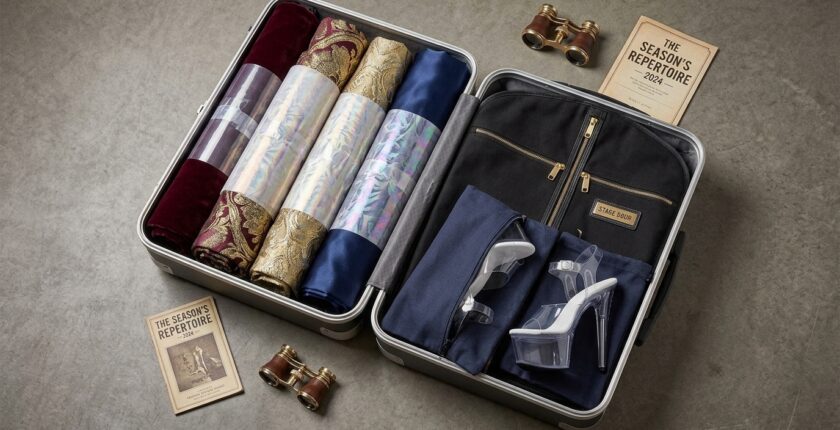
Protecting Your Costumes in Transit: A Touring Performer’s Packing Guide
Why Costume Packing Is a Skill Worth Taking Seriously
Knowing how to pack costumes for travel without damage is one of those practical skills that separates a polished touring performer from one who spends the first hour of every booking with a steamer and a sewing kit in a panic. For feature showgirls and exotic dancers carrying elaborate, structured or heavily beaded pieces, a mishandled bag can mean a ruined show.
This guide is written for performers who travel with more than a few bikini tops. If your kit includes beaded gowns, structured bodices, feathered headpieces, or purpose-built props, the stakes are higher — and the packing strategy needs to match.
Know What You’re Actually Packing Before You Pack It
Start by categorising your show pieces by their vulnerability, not by size. A heavily beaded corset is more fragile than a feather boa three times its volume. A structured headpiece with wire framing needs entirely different treatment from a stretch costume that rolls flat. Group pieces by type before you decide what goes where.
The categories that matter most for a feature act are:
- Beaded and sequinned pieces — prone to snagging, bead loss and fabric distortion under pressure
- Structured garments — bodices, corsets, structured bras — which can warp if compressed
- Feathered items — boas, fans, headpieces — which crush permanently if packed under weight
- Wire-framed props and headpieces — which bend out of shape if not supported
- Stretch and jersey pieces — the most forgiving; roll them
Carry-On vs Check-In: The Decision That Matters Most
The single most important packing decision you make is what goes in the cabin and what goes in the hold. Checked baggage gets stacked, thrown, compressed and occasionally lost. If a costume is irreplaceable or the centrepiece of your act, it belongs with you in the cabin wherever possible.
Most airlines permit one carry-on bag and one personal item. A soft-sided garment bag, folded in half, often qualifies as a personal item and fits in an overhead locker. This is the most reliable way to transport one or two key pieces without risking hold damage. Check your airline’s specific carry-on dimensions before you travel — they vary, and enforcement varies too.
For pieces that must be checked, a hard-shell suitcase with internal compression straps offers meaningfully better protection than a soft bag. The shell resists crushing from above; the straps prevent items shifting and grinding against each other mid-flight.
What Should Always Travel in the Cabin
- Your most expensive or most difficult-to-replace costume
- Structured headpieces or wire-framed props (if dimensions allow)
- Any item that cannot be repaired or replaced in the destination city
- Spare costume jewellery and fastenings — clasps, hooks, spare beads
Folding, Rolling and Wrapping: The Right Method for Each Piece
Rolling works well for stretch fabrics, jersey, mesh and unstructured pieces. It reduces creasing and saves space. It is the wrong method for anything structured, beaded or feathered.
Beaded and sequinned garments should be folded as few times as possible, with the decorated surface facing inward against itself — bead to bead rather than bead to lining. Interleave layers with acid-free tissue paper to prevent snagging. Tissue is lightweight and takes up almost no space; pack a roll of it as standard.
Structured pieces — bodices, corsets, underwired bras — should be packed upright where possible, or supported with rolled socks or soft fabric stuffed into the cup or body to hold the shape. Never pack them flat under other items.
Feathered pieces are the most unforgiving. A crushed feather boa can be steamed back to life; a crushed feathered headpiece with a wire frame often cannot. If the piece is small enough, carry it in a rigid hat box or a purpose-made prop case. If it must be checked, pack it on top of everything else, never underneath, and use a hard-shell case.
Garment Bags: When They Help and When They Don’t
A breathable fabric garment bag protects hanging pieces from dust, snags and light abrasion. It is useful for gowns and longer pieces when you have access to a wardrobe rail — in a hotel room, for instance, or when hand-carrying to a venue.
Inside a suitcase, a garment bag adds little structural protection on its own. Fold the bagged garment carefully and place it on top of the pack, not beneath heavier items. The bag’s real value is keeping the piece clean and preventing contact with other fabrics in transit.
Props and Rigid Items: Cases and Padding
If your feature act includes rigid props — fans, canes, structured frames, specialty equipment — a hard-shell prop case is worth the investment and the extra baggage fee. Foam-lined instrument cases (designed for cameras or musical equipment) are widely available, customisable with cut foam inserts, and far more protective than wrapping a prop in clothing and hoping for the best.
For touring performers who work the same circuit regularly, a labelled, purpose-packed prop case becomes part of the logistics rhythm. It also speeds up venue arrival: everything has a place, and you know immediately if something is missing.
Poles and large apparatus are a separate matter entirely — most touring feature performers who use a house pole confirm specifications directly with each venue in advance. Never assume a venue’s pole matches your training equipment in diameter, height or base type.
Protecting Costumes from Moisture and Compression Damage
Checked luggage can sit on a wet tarmac or in a damp hold. Plastic garment covers — the kind that come from a dry-cleaner — offer basic moisture protection for pieces that can’t go in the cabin. Sealed zip-lock bags work well for smaller accessories, spare fastenings and anything with metal components that might tarnish.
Silica gel sachets are worth adding to any bag carrying beaded or metallic pieces. They are inexpensive, weigh almost nothing and absorb the ambient moisture that causes tarnishing and fabric deterioration on long hauls or in humid destinations.
Compression damage is the other main risk in checked bags. Distribute weight so that heavier items sit at the base of the case (the wheels end, when upright), with fragile pieces on top. Never overfill a suitcase — the pressure from forcing a zip closed is transmitted directly to whatever is packed tightest inside.
What to Do If a Costume Arrives Damaged
Document everything before you leave. Photograph each costume laid flat, before packing. If a piece arrives damaged and you need to make a claim on travel insurance, you need evidence of its condition prior to travel. This takes ten minutes and is easy to skip — until you need it.
If a bag arrives visibly damaged from the hold, report it to the airline at the baggage carousel before you leave the terminal. Most carriers have a limited window — often 24 hours for visible damage, seven days for concealed damage — within which a claim must be lodged. Leaving the airport without reporting reduces your options significantly.
For on-the-road repairs, a small kit goes a long way: a needle and thread in multiple colours, spare hooks and eyes, clear nail polish (for stopping a run or sealing a loose bead thread), fabric glue, and double-sided fashion tape. None of this replaces a costume; all of it buys time until you can get to a proper repair.
Travel Insurance for Contractors
As a self-employed contractor — which most touring performers are — your costumes are working equipment. Standard travel insurance policies vary widely in how they treat high-value items and professional equipment. Read the policy schedule carefully: some policies exclude “professional equipment” from standard baggage cover, or cap individual item claims well below the replacement value of a quality costume.
Look for a policy that explicitly covers professional or performance equipment, or consider a separate specialist contents policy for your kit. Keep receipts for significant costume purchases — they are both a tax record and an insurance requirement if you ever need to claim.
Building a Packing System That Travels With You
The performers who manage touring logistics well tend to have a repeatable system rather than a fresh improvisation before each trip. That means dedicated packing materials that live in your kit — tissue paper, silica sachets, a garment bag, a small repair kit — and a consistent order of pack that you do the same way every time.
It also means being realistic about what you can carry. A feature act with multiple costume changes and props is a significant logistical undertaking. If a booking requires more kit than you can manage safely on your own, that is worth factoring into your conversation with the venue before you accept.
If you tour a feature show and are looking for international bookings, you can put your listing forward with Busama here. For current opportunities across multiple markets, the full jobs archive is a good starting point — including live listings in Auckland, Christchurch and Wellington for performers with the right to work in New Zealand.
If you’re new to working with Busama, the How It Works page covers the process, and the FAQs address the most common questions. When you’re ready to apply, the quick application form is the fastest way to get your details in front of the team.