
What Venues Actually Look for When Booking a Feature Showgirl
Understanding What a Venue Is Actually Buying
If you want to understand how to get booked as a feature showgirl, start by thinking like a programmer. A venue booking a feature act is not filling a floor shift — it is buying a headline moment. The decision-maker is weighing whether your show will deliver something the room will talk about, and whether working with you will be straightforward.
Those two questions — will it land? and will it be easy? — sit behind almost every booking decision. The criteria below flow directly from them.
Show Length and Structure
Most venues have a clear idea of where a feature act fits in the night’s schedule. A show that runs significantly over or under that window creates a programming problem before it even opens. Know your running time precisely — not “around fifteen minutes” but the actual duration of each set you offer.
If you perform multiple acts, be ready to describe each one’s length and energy level separately. A venue may want a longer opening set and a shorter, higher-impact closer, or vice versa. The more clearly you can articulate your options, the easier you make the conversation.
Structure matters too. A well-paced act with a clear arc — build, peak, resolution — reads as professional to anyone who has watched enough stage shows. Venues that book feature performers regularly will notice the difference between a constructed show and a collection of moves.
Production Value: What You Bring to the Stage
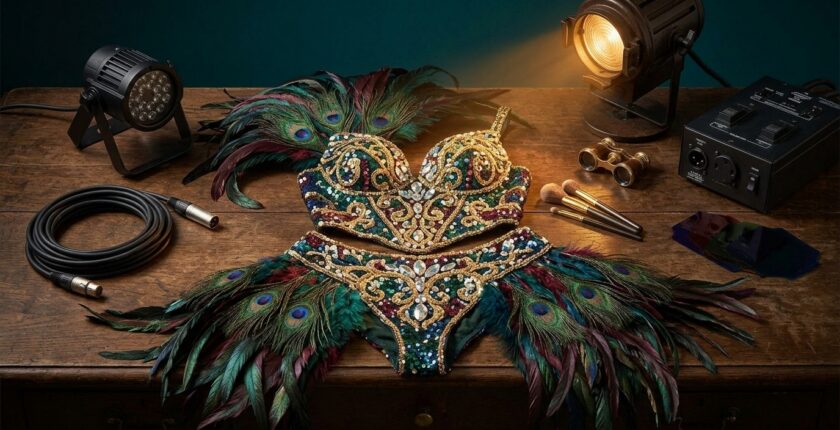
Production value does not mean expensive. It means deliberate. A themed act with a cohesive costume, matched music and considered staging will outperform a technically stronger performance that looks assembled on the night.
Venues assess production value partly on what they can see in your submission materials, and partly on what you tell them you bring. Be specific:
- How many costume changes, if any?
- Is the costuming purpose-built for this act, or general performance wear?
- What is the visual theme, and how consistently does it run through the show?
- Are there props, and if so, what are they?
A venue with a strong visual brand — a particular aesthetic or clientele — is looking for acts that complement it. The more clearly you can describe your show’s look and feel, the better a programmer can picture it on their stage.
Self-Containment: The Detail That Separates Working Showgirls from the Rest
Self-containment is one of the most practical things a venue assesses, and one of the most overlooked by performers pitching for the first time. A self-contained act is one that arrives ready to perform without requiring the venue to solve problems on your behalf.
At minimum, this means:
- Your own music, properly formatted. Know what format the venue’s system requires. Arrive with backups. Never assume the house can pull your track from a streaming service on the night.
- Cue sheets or technical notes. If your act has lighting cues, sound levels or a specific intro sequence, document it. Hand it to the sound and lighting operator before the show, not during it.
- Props and rigging requirements confirmed in advance. If your act requires a specific apparatus — a low-hang point, a particular stage configuration, a prop that needs to be pre-set — that conversation needs to happen before you accept the booking, not when you arrive for load-in.
A venue that has been burned by a feature performer who needed extensive hand-holding will remember it. One who arrived organised, communicated clearly and performed without incident will get called again.
The Rider Question
Some feature performers work with a rider — a list of requirements the venue agrees to meet. If you have one, keep it proportionate and reasonable. A rider that runs to multiple pages for a single-night booking signals that working with you will be high-maintenance. Cover the genuine necessities: dressing room access, load-in time, technical requirements. Save the rest.
Professionalism: What It Looks Like Before You Arrive
By the time a venue sees you perform, they have already formed an impression based on how you communicated. Response times, clarity, accuracy of information and the quality of your submission materials all feed into a booker’s sense of whether you will be easy to work with.
Slow replies, vague answers to direct questions, or submission materials that are difficult to navigate are all friction. Friction makes a booker look at the next submission in the pile.
Equally, a performer who asks sharp questions — about stage dimensions, load-in times, audience profile, whether the show is announced or a surprise — signals that she has done this before and is thinking about the performance, not just the fee.
What a Strong Submission Actually Contains
If you are pitching to a venue directly, or putting yourself forward through a representation platform, your submission is doing the selling before you say a word. A strong submission for a feature booking typically includes:
- Show footage. Clean, well-lit, ideally from a recent live performance. Venues want to see the act in a room with an audience, not a rehearsal recording in a studio. Multiple angles help if you have them.
- A clear show description. Theme, running time, number of sets, costume overview, any apparatus or technical requirements. One page is usually enough.
- Professional photos. In costume, in character. These are used for promotional material — if they are not usable for print or digital promotion, they slow the booking process.
- References or a booking history. A list of venues you have performed at, or a contact who can speak to your professionalism, carries real weight with programmers who do not know your work.
For a practical overview of how the application and placement process works, the How It Works page and the Dancer Jobs and Booking Process page are worth reading before you submit anything.
How to Get Booked as a Feature Showgirl Through Busama
Busama actively recruits experienced feature performers — themed, choreographed, costumed solo acts booked as a headline draw. If you tour a show or are developing one, you can put your listing forward through the Feature Entertainers and Showgirls page.
The page is an active acquisition point, not a passive directory. Submitting there puts you in front of the screening process and, once placed, in front of venues that are specifically looking to book feature acts — not just fill a roster.
Busama’s placement model is built around pre-vetted performers with confirmed legal working status. That vetting process is what gives venues confidence in a booking. It also means that when you are placed, you are not competing against unscreened submissions — the field is smaller and the venues are serious.
For general applications and to explore what roles are currently available, the Exotic Dancer, Pole Dancer and Hostess Jobs page covers the full range of listings. There are also live venue positions across New Zealand, including Auckland and Christchurch, for performers considering that market.
A Note on Work Rights
You must already hold legal working status for any country you intend to perform in. Arranging and confirming that is your own responsibility — check the relevant government immigration source or speak to a qualified migration professional before you apply. Busama’s Visa Information page sets out the agency’s compliance position clearly.
The Practical Edge
Most feature performers who struggle to get booked are not struggling because their act is weak. They are struggling because their submission is incomplete, their communication is slow, or their technical requirements are unclear. Those are fixable problems.
If you have not yet read through the basics of putting together a strong application, these application tips cover the fundamentals. And if you want to stay across new listings and opportunities as they come through, the dancer email list is the simplest way to do it.
The venues booking feature acts are looking for performers who make the process easy and the show worth it. Get both of those right, and the bookings follow.