
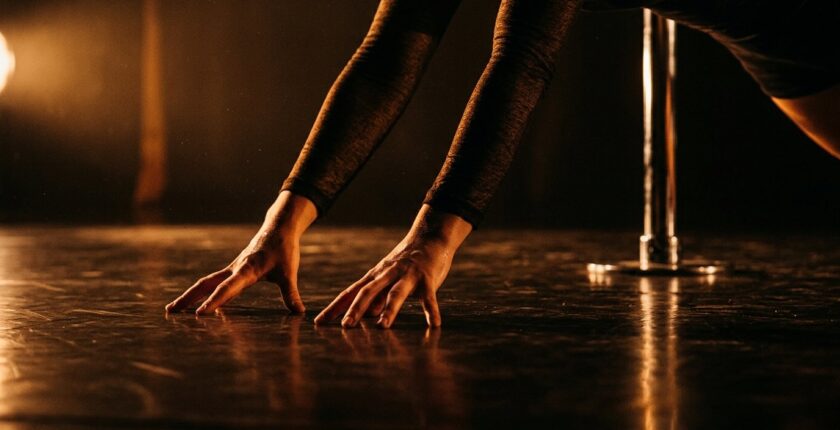
Floor Work Transitions: Connecting Pole Tricks to the Ground
Why Floor Work Transitions Are the Weakest Link in Most Sets
Ask a dancer what she practises most and she’ll name a trick: an invert, a spin, a static hold. Ask her what the audience actually watches and the answer is everything in between. Pole dancing floor work transitions — the moments when you leave the pole, move across the stage, and return — are where a set either flows or stalls.
A dead moment on stage is louder than a dropped trick. The audience doesn’t always know what went wrong; they just feel the energy drop. Fixing that is less about adding material and more about connecting what you already have.
This guide is for working dancers who already have a set and want to make it cohesive — not a beginner’s introduction to floorwork, but a technical look at the transitions themselves.
The Descent: Leaving the Pole With Intention
The most common dead moment in a set is the dismount. A dancer finishes a combination, slides or steps off the pole, and then — nothing, for two or three counts — before the next section begins. The audience reads that pause as uncertainty, even if it isn’t.
The fix is to treat the descent as choreography, not a reset. Every exit from the pole should already know where it’s going.
Controlled versus collapsed descents
A controlled descent uses the pole as a guide wire — your hands maintain contact as long as they’re useful, and you peel away only when the floor has your weight. A collapsed descent (dropping quickly to the floor with no shape) can work as a deliberate stylistic choice, but it needs to be committed. Half-committed looks like a stumble.
Before your next rehearsal, identify every point in your set where you leave the pole. For each one, ask: where does my weight go first, and what is my body doing on the way down? If the answer is “I’m not sure,” that’s the section to drill.
Using the last beat of a combination
The final beat of a pole combination is the natural launch point for a transition. If you’re ending a spin on a strong beat, let the momentum carry you into a directional step or a controlled sink to the floor rather than stopping it dead. Choreographically, you’re extending the phrase rather than ending it — and the audience experiences the set as continuous.
Moving Across the Stage: Shape, Direction and Tempo
Once you’re on the floor, you have the full stage available. Most dancers use a fraction of it. Floorwork that stays within arm’s reach of the pole reads as hesitant; floorwork that travels reads as ownership of the space.
The practical constraint is that you need to get back to the pole. That means every floor phrase has to be designed with its endpoint in mind — not improvised until you find yourself too far away and have to walk back.
Plan your floor path before you choreograph the moves
Draw the stage as a rectangle and mark your pole. Now draw the path you want to travel during a floor section — a curve, a diagonal, a figure-eight. Then choreograph movement that fits that path, rather than choreographing moves and hoping they end up somewhere useful.
This sounds obvious, but most dancers work the other way. They learn a floorwork sequence in isolation and then try to fit it into the set. The path approach forces you to think about spatial storytelling from the start.
Tempo changes as transitions
A shift in tempo — slowing right down or accelerating suddenly — functions as a transition in its own right. It signals to the audience that a new section has begun, which means you don’t need a physical pause to mark the change. A slow, deliberate floor crawl followed by a sharp, fast return to the pole is a complete dramatic arc. The contrast does the work.
Tempo shifts also help with the practical problem of covering distance. A slow section buys you time to travel further across the stage without it looking like you’re rushing to get somewhere.
The Return: Getting Back to the Pole Without Breaking the Set
The return to the pole is the mirror image of the descent — and it gets even less attention in most rehearsal processes. Dancers often treat it as a practical necessity rather than a choreographic moment, which means it reads exactly that way on stage.
Approach angles and momentum
How you approach the pole determines what you can do when you get there. Coming in from directly in front limits your options; approaching from an angle or from behind opens up a wider range of entries — a spin entry, a climb entry, a hip-first wrap. Decide the approach as part of the floor phrase, not after it ends.
If you’re using momentum from a floor roll or a travelling sequence, you can carry that momentum directly into a pole spin. The energy doesn’t have to stop at the pole — it can flow through it. This is one of the most effective ways to eliminate the dead moment entirely: the pole becomes a pivot point in a continuous phrase rather than a destination you arrive at and then restart from.
Bridging with upper body and arm lines
When the lower body is transitioning — travelling across the floor, rising from a low position — the upper body and arms can maintain visual interest and keep the phrase alive. A strong arm line reaching toward the pole before you get there tells the audience where you’re going and builds anticipation. It also means the transition has already begun before you physically arrive.
This is a technique borrowed from contemporary dance and it translates directly to stage performance. The body leads the eye; the eye follows intention.
Musicality: Letting the Track Do Some of the Work
The strongest transitions are musically motivated. When a floor transition lands on a musical hit, a bass drop, or a phrase break, it feels inevitable rather than arbitrary. The audience doesn’t consciously notice the transition — they just feel that the set is tight.
Map your track before you choreograph. Mark the phrase breaks, the dynamic shifts, the moments where the music changes texture or energy. Those are your natural transition points. Build your pole-to-floor and floor-to-pole moments around them and the choreography will hold together structurally, not just visually.
What to do when the music doesn’t give you obvious cues
Some tracks — ambient, electronic, or heavily layered — don’t have obvious hit points. In that case, you create the structure yourself by choosing a consistent rhythmic unit (every eight counts, every sixteen) and making your transitions land on those boundaries. The audience won’t count, but they’ll feel the regularity as coherence.
Drilling Transitions in Isolation
Most performers rehearse their set from beginning to end. The problem with that approach is that transitions get glossed over every time — you arrive at a shaky moment, push through it, and move on. The shakiness compounds.
Drill transitions as their own units. Take a single descent, a single floor phrase and a single return, and run that loop twenty times. Isolating the connective tissue forces you to solve the problem rather than paper over it. Once the transition is clean in isolation, reintegrate it into the full set.
This is standard practice in contemporary and classical dance training. There’s no reason it shouldn’t be standard in stage performance preparation for working dancers too.
Taking Your Set on the Road
A well-constructed set with clean pole dancing floor work transitions is a more bookable set. Venues that programme feature acts — and audiences that pay to see them — notice the difference between a collection of tricks and a performance with shape and intention.
If you’re touring a feature act or building toward one, the feature entertainers listing at Busama is the place to put your work in front of clubs that book headline performers. The Golden Pole video competition is also worth watching — clubs looking to sponsor the format will be looking at the calibre of performers who enter.
For working dancers looking for stage time to develop and perform their sets, there are currently live listings across New Zealand — Auckland, Christchurch, Wellington and Queenstown — as well as a full international jobs archive if you’re considering other markets.
When you’re ready to apply, the quick apply form is the fastest way to get your profile in front of the Busama team.
The floor is part of your stage. Use all of it.