
Feature Show Costume Quick-Changes: Staging Them So They Look Intentional
Why the Change Itself Is Part of the Show
A quick-change that reads as a pause is a quick-change that hasn’t been staged. The audience notices the interruption, the energy drops, and the act loses the momentum you spent two minutes building. Done well, a feature show costume quick-change technique is invisible — or better, it becomes a moment of its own: a reveal, a transformation, a beat that drives the story forward.
This guide is for feature performers who already have a show and want to engineer the change into the choreography rather than around it. It covers fastening systems, sightline management, the handoff, and how to rehearse until the mechanics are muscle memory.
Engineering the Costume: Fastenings First
The costume determines what’s possible. If you’re designing or commissioning a piece with a quick-change in mind, the fastening system is the first decision — not an afterthought.
Velcro, Snaps and Breakaway Seams
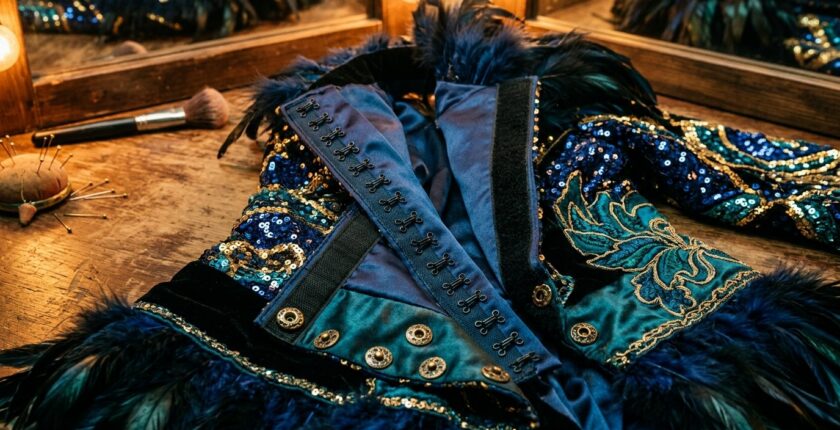
Industrial-grade hook-and-loop (Velcro) is the workhorse of the quick-change. Sewn in strips along side seams, it allows an entire garment to be pulled apart in one motion. The trade-off is sound: a loud rip mid-performance can shatter a mood. Mitigate this with strategic placement — run the Velcro along the back or the inner seam, away from microphones, and time the separation to a musical peak where the sound is masked.
Large, flat snap closures — the kind used in theatrical costuming rather than domestic sewing — offer a cleaner release with less noise. They work best on structured bodices and skirt waistbands. Test them under tension: a snap that pops open mid-act because a seam pulled too tight is a different kind of problem entirely.
Breakaway seams — basting stitches designed to tear on cue — are used in theatrical productions and can work in a feature act, but they are single-use. If you’re doing multiple shows in a run, you’ll need a costume technician to resew between performances. Factor that into your touring logistics.
What to Avoid
Zips are almost always the wrong choice for a quick-change layer. They require two hands, a specific angle, and fine motor coordination — exactly what you don’t have at pace under lights. If a zip is structurally necessary on a base layer, replace it with a concealed Velcro placket for the performance version.
Lacing and corset backs are beautiful on stage but take ninety seconds minimum to undo safely. Keep them for opening pieces you’re wearing from the wings, not for anything that needs to come off mid-act.
Staging the Sightlines
Where the audience is looking during the change is as important as how fast the change happens. Good staging directs attention away from the mechanics and toward something more interesting.
Use the Stage Geography
The standard approach is to position the change upstage or in a partial wing, so the audience’s eye-line is broken by the performer’s own body or the set. A half-turn away from the house — combined with a strong arm gesture or a prop interaction — gives you two to three seconds of cover that feels intentional rather than evasive.
Lighting is your most powerful tool here. A sharp spotlight pool that narrows at the moment of the change keeps the audience focused on your face and upper body. If you have control over your lighting cues, programme a brief intensity shift — a dip or a colour change — to coincide with the reveal. The audience’s visual system resets, and they see the new costume as if for the first time.
The Reveal Moment
The change shouldn’t end when the costume comes off. It should end when you choose to show the new one. A common mistake is completing the physical change and then resuming movement before the reveal has landed. Instead: change, pause one beat, then turn or step forward into the light. Give the audience a moment to register what they’re seeing. That beat is the payoff — don’t rush through it.
The Handoff: Working With a Dresser
For anything faster than about eight seconds, you need a dresser in the wings. This is not a sign that the change is too complicated — it’s standard practice in theatrical and cabaret performance. The question is how to make the handoff seamless.
Positioning and Cues
Your dresser needs to know exactly where you will be standing, which direction you’ll be facing, and which piece comes off first. Rehearse this as a physical sequence, not a verbal instruction. The dresser’s hands should know what to reach for before you arrive at the wing — there is no time for visual searching mid-change.
Establish a physical cue: a touch to the shoulder, a specific hand position, something that tells the dresser “I’m ready, go.” This removes the ambiguity of whether you’ve finished the choreographic phrase before the change begins.
Laying Out the Incoming Costume
The incoming costume should be pre-staged in the order it goes on, opening outward, with every fastening already undone or pre-set. If you’re stepping into a skirt, it should be on the floor in a ring, ready to step into and pull up in one motion. If a headpiece is part of the look, it goes on last — after the body of the costume is secured — and should be within arm’s reach without the dresser having to turn away.
Test the layout in low light. Your dresser may be working in near-darkness in the wings. If they can’t find the opening of a sleeve by touch alone, the layout needs to change.
Rehearsing the Change Until It Disappears
The mechanics of a quick-change need to be rehearsed to the point where they require no conscious attention. That means running the change — not just the surrounding choreography — as a standalone drill, at full pace, until the sequence is automatic.
Drilling the Sequence
Start slowly and build speed. Run the change ten times in a row, then rest, then run it again. You’re building procedural memory, the same way you drill a technical pole sequence or a floorwork transition. The goal is that even under adrenaline, in an unfamiliar venue, with a different dresser, the sequence runs correctly because your hands know what to do.
Time every run. Know your baseline — how long the change takes when everything goes right — so you can identify when something in the staging or the fastening system is adding time. A change that takes four seconds in rehearsal and seven seconds in performance has a problem somewhere in the chain, and you need to find it before opening night.
Rehearsing With the Actual Dresser
If you’re touring a show and using a venue’s in-house crew as dressers, build in a dedicated rehearsal with that person before the first performance. Walk them through the sequence at half-pace, then full pace. The familiarity you’ve built with a regular dresser doesn’t transfer automatically to someone new. Give them the same physical cues, the same layout, and enough repetitions that they’re confident rather than tentative.
Integrating the Change Into the Narrative
The strongest quick-changes in a feature act aren’t just logistical — they’re dramaturgical. The costume change marks a shift in character, energy or story. If your act has a clear arc, the change should coincide with a turning point: the moment the character transforms, the mood inverts, the tempo shifts.
Think about what the audience should feel at the moment of the reveal. Surprise? Recognition? Delight? Build the choreography in the eight bars before the change to create anticipation, and the eight bars after to pay it off. When the change lands correctly, the audience response tells you — the energy in the room lifts, and the second half of the act has a different quality to the first.
That lift is what you’re engineering. The fastening system, the sightlines, the dresser’s hands, the lighting cue — all of it exists to produce that single moment of transformation. Get the mechanics right, and the artistry takes care of itself.
Putting Your Feature Act to Work
If you’re touring a choreographed feature show and looking for venues that book headline acts, you can put your listing forward with Busama here. Busama works with venues across New Zealand, including Auckland, Christchurch, Wellington and Queenstown, and places pre-vetted performers with confirmed legal working status — so the venues you’re presented to are already expecting a professional.
If you’re interested in how the placement process works, the booking process page covers what to expect. For performers ready to apply, the quick-apply form is the fastest way to get in front of the team.
Busama is also developing an online video competition for pole and feature performers — clubs looking to put their name behind the format can register interest as a sponsor through that page.