
Music Editing for Your Stage Set: Structure, Pacing and the Moment That Lands
Why Your Music Edit Is as Important as Your Choreography
A well-crafted exotic dancer stage set music edit is one of the most underrated tools in a performer’s kit. Choreography and costuming get most of the attention, but the music structure underneath them is what actually controls the audience’s emotional experience. Get it wrong and even strong movement falls flat. Get it right and the room does the work for you.
This guide is for feature performers building a full act and for house dancers who want a signature set that feels intentional rather than improvised. The principles are the same either way — only the scale differs.
If you’re new to the idea of custom edits, this earlier piece on music and the exotic dancer industry gives useful context on why the relationship between performance and sound matters so much in this space.
Before You Open a Single Track: Know Your Set Length
Everything in a music edit flows from duration. A house dancer’s set at a gentlemen’s club typically runs three to four songs — roughly nine to twelve minutes depending on the venue’s format. A feature showgirl act might be condensed to six or seven minutes of pure performance. A headline show can stretch to fifteen or twenty.
Each length demands a different architecture. A six-minute act has almost no room for a slow build — you need to establish energy within the first thirty seconds. A fifteen-minute show can afford a genuine journey: a quiet, atmospheric open; a sustained middle section; a peak; a resolution. Know your canvas before you cut a single bar.
Talk to the venue before you finalise anything. Stage size, sound system quality, and whether there’s a DJ or a fixed playlist all affect what your edit needs to do. Check current listings for venue-specific details, or ask the Busama team what the setup looks like at the club you’re considering.
The Four-Part Structure
Most effective stage sets — regardless of genre, theme or length — follow a four-part arc. Think of it less as a formula and more as a map of audience attention.
1. The Intro: Establish, Don’t Exhaust
Your opening thirty to sixty seconds sets the contract with the audience. It tells them what kind of act this is, what emotional register to settle into, and whether to lean forward or sit back. It should not be your biggest moment.
A common mistake is opening at full intensity — a hard drop, a fast tempo, maximum energy from bar one. The problem is there’s nowhere to go. If you peak in the first minute, the next nine feel like a slow deflation.
Instead, open with something that creates expectation. A slow, atmospheric build. A strong visual moment — a pose, a reveal, a costume piece — that lands on a musical cue rather than fighting against it. The tempo can be moderate; the mood should be unmistakable. Feature performers designing a themed act will find this especially important: the intro is where the concept is established, not explained.
2. The Build: Managing Tension Over Time
The middle section of your set is where most edits either succeed or collapse into repetition. Its job is to hold attention while moving the audience steadily toward your peak. That means managing energy in waves rather than sustaining one flat level.
Vary tempo deliberately. A section at 128 BPM followed by a brief drop to 96 BPM — even for sixteen bars — creates contrast that makes the return to pace feel like a surge. Producers use this constantly; so should you when editing.
Silence, or near-silence, is one of the most powerful tools available and one of the least used. A full stop in the music — even for two or three seconds — resets the audience’s attention completely. What comes after a moment of silence lands harder than anything that follows continuous sound. Use it sparingly, but use it.
Transitions between tracks are where amateur edits fall apart. A jarring key change or a clumsy tempo splice breaks the spell immediately. If you’re editing across multiple songs, aim for one of three clean transition types: a crossfade that blends the outro of one track into the intro of the next; a hard cut timed precisely to a downbeat; or a musical bridge — a drum fill, a vocal stab, a sound effect — that signals the shift intentionally. The listener should feel the change as deliberate, not accidental.
3. The Peak: One Moment, Earned
Every set should have one moment that is unmistakably the centrepiece. Not two moments, not a sustained plateau — one specific beat, phrase or musical event that the entire edit has been building toward.
This is the moment your best technical element lands. The aerial. The costume reveal. The floor sequence that required three months of conditioning. Whatever it is, it needs to be synchronised with a musical event of equal weight: a chorus drop, a key change upward, a sudden increase in orchestration, a vocal hook.
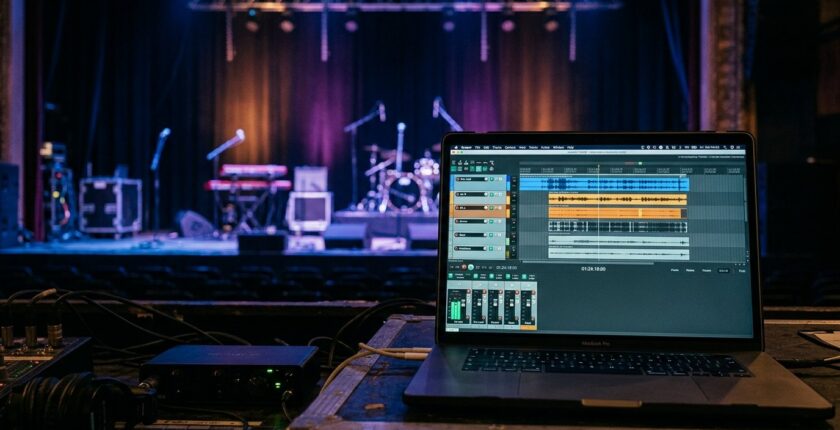
Timing this correctly requires editing in your DAW (digital audio workstation) at the bar and beat level, not just by feel. If you’re new to audio editing software, tools like Audacity (free), GarageBand, or Adobe Audition give you the precision you need. Work with the waveform visible so you can see exactly where the energy spikes in the track, and cut your choreography map to match.
For feature performers, this is also the moment your theme crystallises. The peak isn’t just athletic — it’s the emotional payoff of whatever story or concept you opened with. If you’re building a choreographed feature act, consider how the musical peak and the narrative peak can be made to coincide.
4. The Outro: Land It Clean
The outro is the most neglected part of any edit. Performers spend weeks on the peak and then let the music run out or fade arbitrarily. The outro is your final impression — it determines whether the room applauds immediately or sits in a slightly confused silence.
A clean outro does two things: it signals clearly that the act is over, and it gives the audience a moment to respond before the next track starts. A hard stop on a final beat — especially after a sustained musical phrase — works well for high-energy sets. A gradual fade works for more atmospheric acts, but must be controlled: fade too slowly and the ending feels uncertain; fade too fast and it feels cut off.
Time your final physical position to land on the last musical event, not before it and not after. If you’re still moving when the music has already ended, the edit is wrong — adjust the cut, not the choreography.
Technical Basics: What You Actually Need
You do not need a professional studio to produce a workable stage edit. What you do need is a DAW with waveform editing capability, good-quality headphones (not just earbuds), and enough time to listen back on the same kind of sound system the venue uses. A mix that sounds balanced on headphones can sound completely different through a large club PA — bass frequencies in particular behave differently at volume.
If the venue has a resident DJ, it’s worth asking whether they can run your pre-edited file directly or whether they’ll be mixing it live. Pre-edited files give you full control over timing; live mixing gives you flexibility if something goes wrong on stage. Know which you’re working with before you finalise your edit.
Export your final file in a lossless or high-quality format — WAV or AIFF rather than a compressed MP3 where possible. Compression artefacts become more audible at high volume, and a muddy-sounding edit undermines an otherwise strong set.
Adapting Your Edit for Different Set Lengths
If you’re touring — playing different venues with different formats — you’ll likely need more than one version of your edit. A fifteen-minute feature show cannot simply be trimmed to six minutes by cutting the middle; the arc collapses. Build shorter versions as separate edits, restructuring the four-part arc to fit the new duration rather than just removing sections.
House dancers building a signature set face a slightly different challenge: the set needs to feel fresh across multiple performances in a single shift. Varying the track order, swapping a section for an alternate mix, or building two or three modular edits you can rotate gives you flexibility without starting from scratch each time.
For more on how the music landscape shapes performance in this industry, this piece is worth revisiting once you’ve worked through your own edit.
Feature Performers: Your Edit Is Part of Your Pitch
If you’re touring a feature act, your music edit is part of your professional package — as important as your show reel or your costume photographs. Venues booking a headline performer want to know that the show is production-ready, not a work in progress. A polished, well-structured edit signals exactly that.
Busama actively works with experienced feature performers and showgirls. If you have a show ready to tour, you can put your listing forward here. And if you’re curious about an online performance competition format for pole and feature performers, the Golden Pole video competition is worth keeping an eye on.
Current listings across New Zealand, the US and Europe are available through the jobs archive. If you’re considering a run in Auckland, this listing is a good starting point. To apply or register your interest, the quick-apply form is the fastest route.
A strong exotic dancer stage set music edit won’t replace technique or stage presence. But it will make everything you’ve worked on land the way it deserves to.