
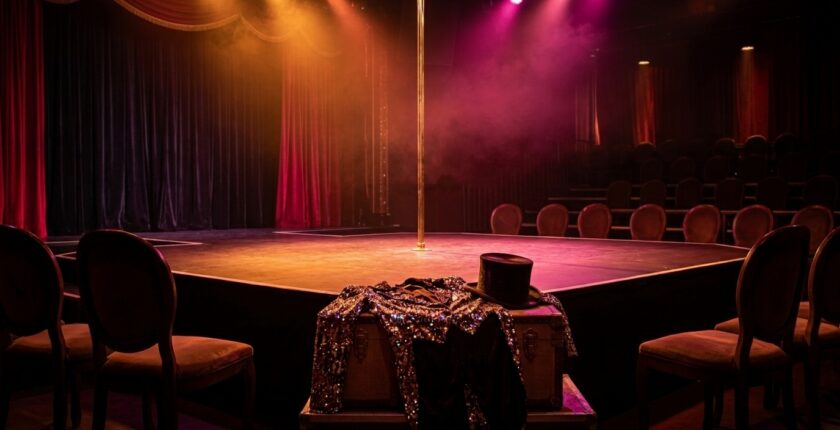
How to Build a Themed Feature Act from Concept to Curtain
From Dance Skills to Headline Act: Why Feature Showgirl Act Design Is Its Own Craft
You can already dance. You know your body, you know a stage, and you know how to hold a room. But a feature act is something different — it is a complete piece of work with a beginning, a middle and an end. Feature showgirl act design is the process of turning your skills into a bookable, repeatable headline show that a venue will pay to fly in.
This guide walks you through that process in order: concept, music, costume, props and blocking. It is written for a performer who is ready to move up, not for someone starting from scratch on a pole.
If you already have a show and are looking for touring bookings, you can put your listing forward with Busama here. If you are still building, read on.
Step One: Lock In a Concept Before You Touch the Music
The single most common mistake in feature act development is starting with a song you love and building outward from it. Music matters enormously — but concept comes first. A concept gives every other decision a filter: does this costume serve the story? Does this prop earn its weight? Does this transition make sense?
A workable concept has three qualities. It is specific enough to generate visual decisions (not “dark and glamorous” but “1920s carnival fortune teller”). It is achievable within your actual budget and touring logistics. And it is distinct — something a booker has not seen a version of in the last six months.
Finding Your Concept
Start with what you already do well physically. A performer with exceptional floorwork will build a different show to one whose strength is pole tricks or fan-veil manipulation. The concept should showcase your best material, not require you to learn a new discipline from scratch.
Write down five themes you could commit to for two years of touring. A feature act is not a one-night piece — you will perform it dozens of times, in different rooms, on different-sized stages, possibly in different countries. Novelty wears off fast when you are the one doing it. Choose something with enough depth that it keeps rewarding you.
Narrow to one. Then write a single sentence that describes what the audience experiences, not what you do: “The audience watches a woman transform from captive to predator” tells you more about staging than “I do a bondage-inspired pole piece.”
Step Two: Music Editing Is Production Design
A feature act runs between six and twelve minutes in most club contexts, though venue expectations vary and you should always confirm the preferred runtime before you accept a booking. That means your music almost certainly needs editing — very few commercially released tracks are the right length, and a medley of multiple tracks needs careful construction to feel intentional rather than patched together.
Invest in a proper edit. Free audio software is available and functional, but if editing is not your skill, pay someone who does it well. A poorly cut track — an abrupt splice, a tempo mismatch, a fade that lands in the wrong place — undermines choreography that would otherwise be strong. The music edit is infrastructure, not decoration. Music has always been central to the exotic dance industry, and in a feature act it carries the entire emotional arc.
Structuring the Arc
Think in three movements. An opening that establishes the world and draws attention — usually slower, more theatrical, with clear visual impact. A middle section that builds energy and delivers your strongest technical material. A close that lands decisively: a held image, a blackout, a costume reveal, something that tells the room it is over and gives them a moment to respond.
Map your choreographic peaks to the musical peaks before you start blocking. If your best trick lands in musical silence, either move the trick or re-edit the music.
Step Three: Costume as Narrative, Not Just Wardrobe
In a standard floor set, costume is presentation. In a feature act, costume is storytelling. Every piece you wear — and every piece you remove or reveal — should serve the concept you locked in at step one.
Think in layers and reveals. What does the audience see at the top of the act? What changes, and when? A reveal that lands at a musical climax is a choreographic moment in its own right. A reveal that happens because it was convenient is a missed opportunity.
Practical Considerations for Touring Costume
A feature act costume that cannot survive a suitcase is a liability. Structured pieces need internal boning or framing that can be disassembled, packed flat and reassembled without professional help. Feathers, crystals and delicate appliqué need hard-sided protection — a dedicated costume case is not a luxury if you are touring the show.
Build at least one backup for any piece that is irreplaceable to the act. A broken headpiece or a snapped corset busk the night before a booking is a genuine professional emergency. Redundancy is not vanity; it is risk management.
Weight and volume matter more than you expect when you are moving between cities. If your full costume and prop load cannot check as standard luggage, factor the excess baggage cost into what you charge. Busama has long recognised the distinct value of choreographed, costumed performance — and venues that book feature acts understand they are paying for production, not just a body on stage.
Step Four: Props — Earn Every Piece or Cut It
Props are the element most likely to make a feature act look either extraordinary or amateur, with very little middle ground. A prop that is fully integrated — that appears at the right moment, serves the narrative, and is handled with confidence — elevates everything around it. A prop that is awkward to set up, difficult to use under pressure, or only tangentially related to the concept draws attention to the seam.
Apply a simple test to every prop you are considering: if it were not there, would the act be weaker? If the honest answer is no, cut it. The best feature acts tend to use fewer props than the performer originally planned.
Logistics and Stage Setup
Know exactly how long your stage setup takes, and practise it until it is automatic. In a club context you will often be setting up while the previous act clears and music transitions — there is no generous tech window. Every prop needs a designated position and a clear removal plan. If a prop cannot leave the stage cleanly, it will break your close.
When you are in conversation with a venue about a booking, ask specifically about stage dimensions, available rigging points, and whether the club has a pole and what specification it is. A show designed around a 45mm static pole does not automatically transfer to a 38mm spinning pole. These are not details to discover on the night.
Step Five: Stage Blocking for Rooms You Haven’t Seen
Feature acts are performed in different rooms, on different stages, in front of different audience configurations. Your blocking needs to be principled rather than fixed — you should know why you face a particular direction at a particular moment, so that you can adapt when the stage is half the size you expected.
Work with a clear sense of your dominant sightlines. In most club configurations, the longest sightline runs from the main stage to the back of the room. Your biggest moments — the reveal, the climax, the close — should play to that line. Secondary moments can play to the sides.
Rehearsing for Variability
Rehearse the act on different-sized floor spaces deliberately. Mark out a smaller footprint and run the full show within it. This forces you to identify which spatial choices are structural and which are just habit. Structural choices survive a smaller stage; habits do not.
Record every run-through from a fixed camera position. Watch it back without sound first — if the visual logic of the act does not read without the music, the blocking needs work. Then watch it with sound. The two should feel like the same piece.
Putting the Show on the Road
A finished, rehearsed, documented feature act is a professional product. Document it properly: a showreel of two to three minutes, shot well, that represents the act honestly. Still images from a professional shoot. A clear technical rider — stage size minimum, rigging requirements, setup time needed, music format.
Venues that book feature acts are making a significant investment. They need to know what they are getting before they commit. A performer who can hand over a clear package — video, images, rider, and a track record — is far easier to book than one who cannot. Understanding how the booking process works from the venue’s perspective will help you present yourself in the right terms.
Live listings where feature and showgirl performers are in demand include venues across New Zealand — Auckland and Christchurch both have current openings. Browse the full jobs archive for the current picture across all markets.
If you are ready to tour a feature act and want to put your show in front of venues that book headline entertainment, submit your listing through Busama’s feature entertainers page. And if you want to test your work in a competitive format, the Busama video competition is a format worth watching as it develops. Ready to apply for your next placement? Start here.