
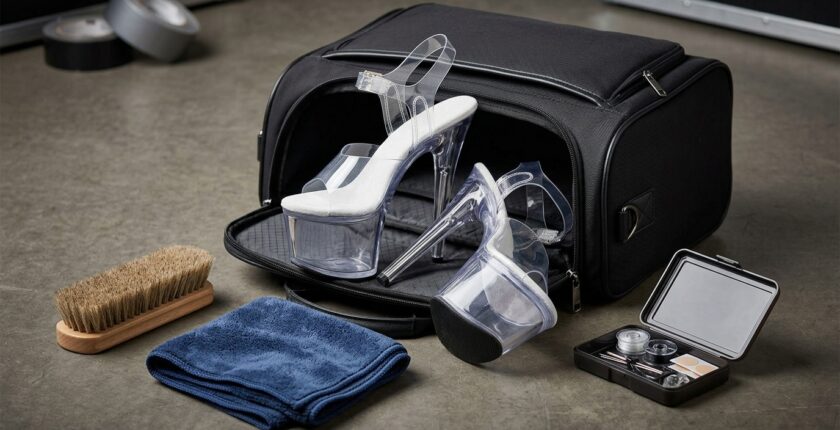
Heels That Last: Choosing and Caring for Platform Shoes on the Road
Your Heels Are a Professional Tool — Treat Them Like One
Exotic dancing platform heels care and maintenance is not a glamorous subject, but it is a practical one. A pair of platforms that falls apart mid-set, or arrives at a new city scuffed and heel-loose, costs you confidence and money. If you tour regularly, your footwear takes more punishment than almost any other piece of kit you carry.
This guide covers the decisions that matter: how to choose the right heel for the work you do, how to make them last, how to fix them on the road, and how to pack them without destroying them in transit.
Choosing the Right Heel Height for Your Performance Style
Platform heels for exotic dancing typically range from around 5 inches to 8 inches in total height, with the platform at the front absorbing much of that rise. The platform is what makes extreme heights wearable — it reduces the actual angle your foot sits at, which matters enormously for sustained performance.
Height selection should follow the demands of your act, not the other way around.
Pole and Floorwork
For pole work, a 6- to 7-inch heel with a solid, wide platform gives you grip on the pole base and enough height for visual impact without compromising ankle stability during inversions. A narrower stiletto platform increases wobble on dismounts — not worth the aesthetic gain. If your set includes significant floorwork, look for a platform with a slightly rounded toe box; it gives you more surface contact when you’re on your knees or transitioning to the floor.
Feature and Showgirl Acts
Feature performers and showgirls often work with choreographed movement across a larger stage, sometimes including prop work or costume reveals. A 5- to 6-inch heel is frequently the practical ceiling here — you need to travel across the stage, hit marks, and manage costume changes. Some feature performers keep two pairs: a taller pair for pole or static poses and a lower, more manoeuvrable pair for walking sections. If you’re building or touring a feature act and want to discuss placement options, you can put your listing forward with Busama here.
Hostess and Floor Work
If your role is primarily floor-based — hosting, table work, or extended periods of walking — prioritise a chunky, stable platform over maximum height. A 5-inch platform with a broad base will see you through a six-hour shift far more safely than a 7-inch stiletto platform that looks better in photos.
What to Look for in Sole and Platform Durability
Not all platforms are built the same. The materials used in the sole and platform construction determine how long a pair will last under professional use — which is very different from occasional wear.
Platform core: Most exotic dance platforms use a wood or dense composite core. Wood is rigid and durable but can crack if the shoe is dropped or compressed hard in a bag. Composite cores are slightly more forgiving. Avoid hollow platforms — they compress and crack faster under repeated impact.
Sole material: A rubber or textured sole grips a stage better than a raw plastic one, and it matters for safety. Some dancers have a cobbler add a thin rubber sole layer to new shoes before they ever wear them on stage. It costs very little and meaningfully extends the life of the sole.
Upper material: Patent vinyl and PVC are the industry standard — they wipe clean, hold their shape, and photograph well. Genuine leather uppers are more breathable but harder to maintain on the road. Fabric or suede uppers look beautiful but are a maintenance burden in a touring context; save them for a specific themed set where the look is worth the extra care.
Heel post construction: The heel post on a platform shoe takes significant lateral force during spins and dismounts. Look for a metal-reinforced heel post rather than a solid plastic one. You can usually tell by weight — a reinforced heel has a slight metallic rattle if you tap it. Plastic-post heels can shear at the base, which is a safety issue, not just a repair inconvenience.
Exotic Dancing Platform Heels Care and Maintenance: The Basics
A consistent care routine keeps heels performance-ready and extends their working life significantly. None of it is complicated, but it does need to be regular.
After Every Shift
Wipe the uppers down with a slightly damp microfibre cloth while they are still warm from use. Body oils, stage product and sweat will degrade vinyl over time if left to sit. Pay attention to the ankle strap and buckle area — product and moisture accumulate there. Let the shoes air out completely before storing them; putting them straight into a bag while damp encourages mould and odour in the lining.
Check the heel post and platform join at the end of each shift. A slight give or creak that wasn’t there before is an early warning sign. Catching it early means a repair; ignoring it means a failure on stage.
Weekly Maintenance
Use a dedicated vinyl cleaner or a small amount of isopropyl alcohol on a cloth to remove any product build-up the damp wipe misses. For patent finishes, a light application of petroleum jelly or a patent-specific conditioner restores shine and prevents micro-cracking. Inspect the sole for wear — particularly at the ball of the foot and the heel tip, which take the most impact.
Heel tips (the small rubber or plastic cap at the base of the heel post) wear down faster than anything else on the shoe. Carrying two or three spare heel tip sets in your kit bag is cheap insurance. They are easy to replace with a heel tip tool or a small hammer and a flat surface, and a worn-down tip affects both your balance and the sound you make on stage.
Repairs on the Road
You will not always be near a cobbler. A small repair kit is a non-negotiable part of a touring dancer’s bag.
The essentials: a tube of strong contact cement or shoe repair adhesive (Barge cement is a widely used trade option), a small flat-head screwdriver, replacement heel tips in your heel post diameter, a nail file for roughing up surfaces before gluing, and a few cable ties for emergency structural holds. A short strip of moleskin padding is useful for managing a blister from a new pair mid-tour.
For a detaching platform sole — where the platform is separating from the upper at the front or side — clean both surfaces, apply contact cement to both, allow it to become tacky (usually 10–15 minutes), then press and hold firmly. Clamp it overnight if you can; at minimum, tape it tightly and let it cure for several hours before wearing. Trying to dance on a freshly glued repair the same night is how you lose the shoe on stage.
For a cracked platform core, contact cement can stabilise a hairline crack, but a structural crack through the core usually means the shoe is done. Carry a backup pair — always.
Packing Heels for Transit Without Destroying Them
Platforms are surprisingly vulnerable in a touring bag. The combination of a rigid structure, a projecting heel post, and a hard platform edge means they damage other items and damage themselves if packed carelessly.
Each pair should travel in its own dust bag or a soft fabric pouch — a pillowcase works perfectly. Stuff the toe box with a rolled pair of socks or a small cloth to maintain the shape of the upper. Store pairs heel-to-toe (one shoe reversed against the other) to reduce the overall footprint in the bag.
Never pack platforms loose in a checked bag with other hard items. The platform core is the most vulnerable point — a heavy item landing on it in transit can crack it clean through. If you are checking luggage, pack heels in the centre of the bag surrounded by soft items, or use a dedicated shoe case for your primary pairs.
For carry-on, a dedicated shoe compartment or a small packing cube keeps the heel posts from snagging on other items. Keep your performance heels in carry-on where possible — a delayed bag the night before an audition or a first shift is a significant problem.
How Many Pairs to Tour With
The practical minimum for a touring dancer is three pairs: a primary performance pair, a backup in the same or similar height, and a lower or more comfortable pair for extended floor shifts or travel days. Feature performers carrying a full show may need more, depending on act requirements.
Rotating pairs between shifts extends the life of each — the materials need time to recover from heat and moisture. A pair worn every night without rotation will degrade noticeably faster than one used on rotation.
If you are looking at upcoming touring opportunities, the current Busama job listings include positions across New Zealand — including roles in Auckland, Christchurch, Wellington and Queenstown — as well as international listings. Having your kit properly sorted before you travel makes the first week significantly easier.
One Final Check Before You Pack
Before any touring engagement, do a full inspection of every pair you plan to bring: sole adhesion, heel post stability, heel tip condition, platform integrity, and strap hardware. Fix or replace anything that is borderline. The time to discover a problem is at home, not at the venue.
Good exotic dancing platform heels care and maintenance is not about vanity — it is about having reliable, safe footwear for every shift of a run. Treat it like the professional kit check it is.
Ready to find your next placement? Apply through Busama here, or check the FAQs page if you have questions about how the process works.