
Packing for a Multi-City Tour: The Exotic Dancer’s Luggage Strategy
Why Packing Strategy Is a Professional Skill
Knowing what to pack for an exotic dancing tour is not a trivial question. Get it wrong and you’re checking a second bag on every flight, paying excess fees that eat into your earnings, or arriving at a venue to find your best costume has spent six hours crushed under someone else’s suitcase.
A multi-city run — four or five stops across a few weeks — demands a system. The performers who tour most efficiently treat packing as part of their professional preparation, not an afterthought. This guide covers the practical mechanics: luggage choice, costume protection, carry-on essentials, and how to manage a working wardrobe across every stop without losing your mind or your margins.
If you’re still putting together your next placement, the Busama job listings are a good starting point for finding where the work is.
Choose Your Luggage Deliberately
Most domestic and international carriers allow one checked bag of 20–23 kg and one carry-on of 7–10 kg, though allowances vary by airline, fare class and route. Before you book anything, check the specific allowance for every leg of your tour — budget carriers in Europe and Southeast Asia are particularly strict, and a single overweight bag can cost more than upgrading your fare class would have.
For a multi-city run, the goal is one checked bag and one carry-on, full stop. Two bags means two opportunities for delays, losses and fees. It also slows down every transit.
Hard-shell vs soft-shell
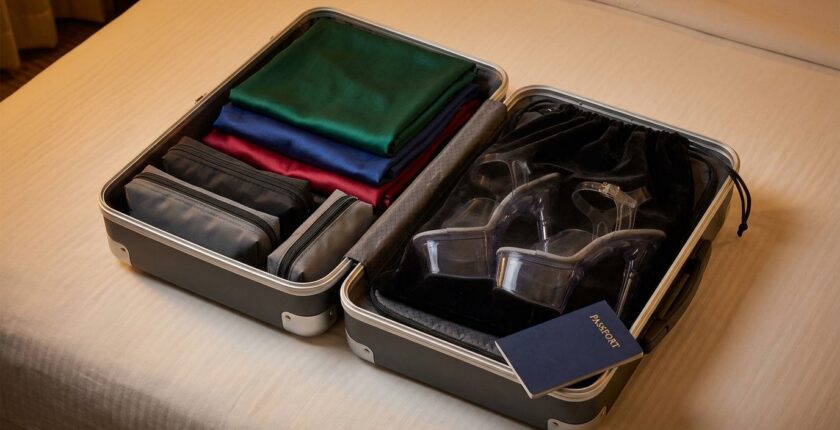
Hard-shell cases offer better protection for rigid costume pieces — structured bodices, wire-framed headpieces, acrylic heels. They compress less under other luggage in the hold. The trade-off is that they don’t flex to absorb extra items the way a soft-shell does.
A mid-size hard-shell (around 65–68 cm) in the 20–23 kg class is the most versatile choice for touring performers. It’s large enough to carry a working wardrobe, small enough to avoid automatic oversize fees on most carriers.
Packing Costumes: Compression, Protection and Order
Costumes are your tools. Treating them like general clothing — folded flat and stacked — is how you arrive with crushed feathers, bent underwires and rhinestones embedded in the wrong fabric.
Use compression bags correctly
Vacuum-style compression bags are useful for soft items: fishnets, lingerie sets, fabric skirts, jersey-knit pieces. They reduce volume significantly without damaging the material. However, they are not suitable for anything with structural boning, embellishment or feather trim — compression crushes all three.
Roll-style compression cubes (no vacuum) are better for structured pieces. They contain the item without applying direct pressure across the whole surface. Pack structured costumes loosely inside a cube with a layer of tissue paper or a clean microfibre cloth between embellished surfaces.
Heels
Platform heels are expensive, heavy and awkward to pack. Each pair should travel in its own dust bag or a soft cloth shoe bag — never loose in a suitcase where the platform edge can catch on fabric or the heel can scratch other items. Place them sole-to-sole, heel-to-toe, and position them along the spine of the case where they’re least likely to shift.
If you’re carrying three or more pairs, consider which ones you genuinely need for every stop versus which are venue-specific. One pair of clear platforms and one pair in a neutral metallic covers most stages. Speciality pairs for a specific act or theme can be assessed stop by stop.
The tissue paper rule
Acid-free tissue paper is cheap, weighs almost nothing, and prevents rhinestone transfer, snag damage and creasing on delicate fabrics. Use it between any two embellished surfaces that will be in contact during transit. It’s worth carrying a small roll in your kit.
What Goes in Your Carry-On
Your carry-on is your insurance policy. If your checked bag is delayed or lost, you need to be able to work the next night. That means your carry-on should contain everything irreplaceable and everything you’d need for one full shift.
The carry-on working kit
- One complete costume — your most versatile set, not your most fragile. Choose something that packs flat and doesn’t require steaming.
- One pair of heels — your most reliable pair, in a dust bag.
- Full make-up kit — stage make-up is not the same as everyday make-up, and replacing it at short notice in an unfamiliar city is time-consuming and expensive.
- Hair essentials — pins, extensions if you use them, heat protectant. Not a full styling kit, but enough to produce a stage-ready result.
- Any prescription medication — always in carry-on, always in original labelled packaging.
- Copies of key documents — digital and physical. Passport photo page, travel insurance policy number, emergency contacts.
Liquids follow standard airline rules: containers of 100 ml or less, in a single transparent resealable bag of no more than one litre. If your make-up kit contains large bottles of setting spray or foundation, transfer to travel-size containers before you fly.
Managing Weight Across a Multi-City Run
The biggest packing mistake touring performers make is starting a run at maximum weight. You have no margin for anything you buy along the way, no margin for a venue supplying fewer amenities than expected, and no margin for the small but real accumulation of receipts, products and items that happens over three weeks on the road.
A practical target is to leave home at around 80% of your checked allowance. That 20% buffer absorbs the tour without forcing you into panic repacking or excess fees at the end.
Laundry planning
On a multi-city run, you will need to wash costumes. Most hotels offer laundry services, but they are slow and expensive for delicate items. A small bottle of travel-size delicate fabric wash and a flat drying rack (the fold-flat type weighs next to nothing) gives you independence. Fishnets, fabric sets and jersey pieces can be hand-washed and dried overnight in most hotel rooms.
Anything with rhinestones, feather trim or structured boning should not be machine-washed. Spot-clean only, and allow adequate drying time before packing — damp fabric packed in a closed case is a fast route to mildew and damaged embellishment.
What to Sort Before You Fly
Packing is the last step, not the first. Before you close the case, confirm the following:
- Travel insurance — as a contractor, you are responsible for your own cover. A policy that includes cancellation, medical, and baggage cover is the baseline. Check whether your policy covers professional equipment, since costumes and heels are working tools, not personal effects in the standard sense. Some specialist travel insurers offer contractor-specific policies worth investigating.
- Venue confirmation in writing — know exactly where you’re going, when you’re expected, and who to contact on arrival at each stop.
- Working status confirmed — you must already hold legal working status for every country on your itinerary before you travel. That is entirely your own responsibility to arrange and verify with the relevant government immigration authority or a qualified migration professional.
For a full overview of how Busama handles placements and what the booking process looks like from your side, the booking process page covers the steps clearly. The FAQs are also worth reading before your first international placement.
Destination-Specific Packing Notes
What you pack shifts depending on where you’re going. A run through New Zealand’s main cities — Auckland, Wellington, Christchurch — involves a temperate climate with significant seasonal variation. If you’re considering placements there, current listings include Auckland, Wellington and Christchurch.
A European summer run — somewhere like Ibiza — means high heat and humidity, which affects both what you wear offstage and how you store costumes between shifts. Rhinestone adhesive can loosen in sustained heat; keep embellished pieces out of direct sunlight and away from car boots or luggage stored in warm holds for extended periods.
Whatever your route, the principle is the same: research the climate, confirm the venue’s facilities, and pack to the specific run rather than to a generic idea of “touring.”
Ready to Plan Your Next Run?
Knowing what to pack for an exotic dancing tour is one part of the preparation. Finding the right placements is the other. Browse the current job listings to see what’s available, or submit your application to be considered for placements that match your experience and working status.
If you want to stay across new listings as they go live, the Busama dancer email list is the simplest way to do it.